
NAAF Walk for Alopecia: Why We’re Taking Part
 September 23, 2026
Views: 375
September 23, 2026
Views: 375
Fall begins in September but it is also much more than that. It is the period when alopecia areata advocates become vocal about their concerns, reach out to other people, and let everyone know that there is a whole lot more to hair loss.
For quite some time now, we at UniWigs have been engaging in discussions on the NAAF Walk for Alopecia. We strongly feel that alopecia patients need something beyond solutions for hair loss. They need empathy, they need guidance, they need relevant information and most importantly, they need a community.
So, what is the NAAF Walk for Alopecia? Why does it matter? And why is UniWigs taking part? Let’s start there.
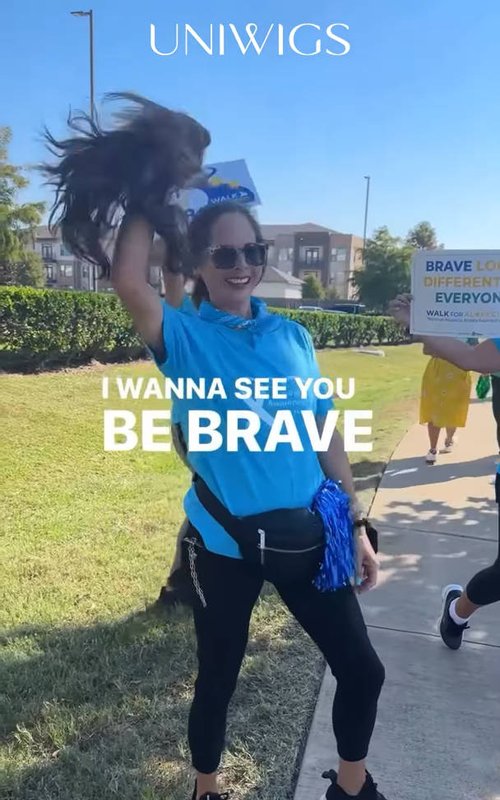
What is the NAAF Walk for Alopecia?
The NAAF Walk for Alopecia is an annual fundraising and awareness walk run by the National Alopecia Areata Foundation. The walk is attended by people with alopecia areata, family members, friends, caregivers, doctors, and everyone else interested in raising awareness, funding research, creating community and eliminating the stigma associated with hair loss.
The date of the major Walk For Alopecia walk is set on September 26, 2026. There are events in the flagship cities of Boston, Philadelphia, and San Francisco, as well as 40+ walks in communities organized by volunteers and virtual Walk Where You Are. Some local events use a different date.
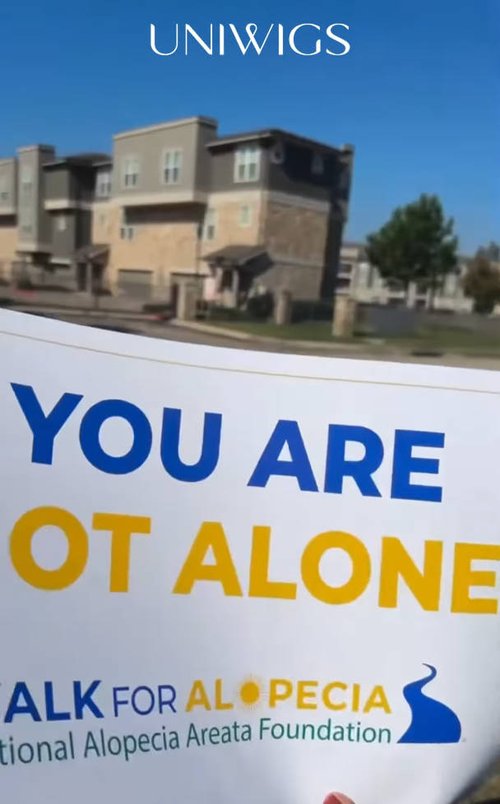
In simple words, it is a walk with a bigger purpose: to show people living with alopecia that they are not alone.
What size is the Walk for Alopecia?
The Walk For Alopecia has been rapidly expanding since its initiation.
In 2023, NAAF has initiated the first Walk For Alopecia event to gather the community, raise money, facilitate research, educate people, and fight stigma.
In 2025, the event has already developed into a much bigger national movement.
According to NAAF, the 2025 Walk featured 4,461 walkers who were registered to take part in the event, 25 official community sites, and more than 85 ”Walk Where You Are” neighborhood teams. Overall, the 2025 event managed to raise $1.265 million and counting, thus surpassing its $1.2 million initial target.
Those statistics demonstrate one thing: people want to join the discussion.
Statistics may change every year, but the message will remain the same: alopecia needs recognition.
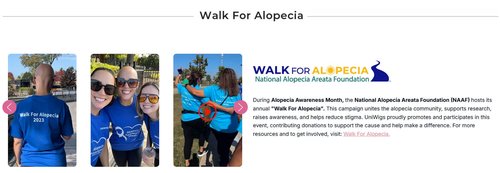
Why is UniWigs taking part in the NAAF Walk?
At UniWigs, we work with people who are dealing with different kinds of hair loss every day.
Some people come to us after noticing a wider part.
Some have thinning at the crown.
Some have visible patches.
Some are living with alopecia and have lost much more hair.
And some simply want a hair topper or wig because it helps them feel more like themselves.
That is why the NAAF Walk feels meaningful to us.
We do not see hairpieces as the whole answer to alopecia. A topper or wig does not treat alopecia, and it does not replace medical care.
But for some people, a hair solution can be one small part of their daily life with hair loss.
It helps someone to feel better about going to work.
It gives someone confidence to go out with his or her friends.
It gives someone the chance to change his or her hairstyle if he or she wants.
Above all, the choice belongs to the one who wears it.
This is the type of message we want to spread.
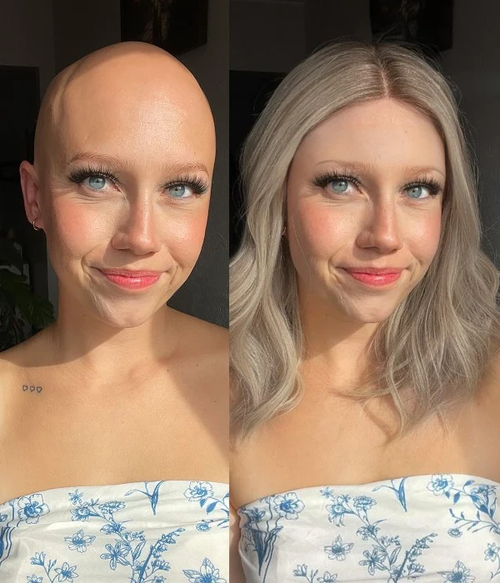
Camille | Pearl Beige Blonde Remy Human Hair Lace Front Wig S/M
Can hair toppers or wigs help people with alopecia?
For some people, yes. Hair toppers and wigs can be used as cosmetic hair solutions to help cover areas of thinning or hair loss.
But the right option depends on the person.
A topper may work well for someone who still has enough hair around the area to support it. A wig may offer more coverage for someone with more extensive hair loss.
Here is a simple comparison:
| Hair solution | Common reason someone may consider it |
| Hair topper | To add volume and cover thinning at the crown or top of the head |
| Larger-base topper | To cover a wider area of thinning or hair loss |
| Full wig | To cover extensive or complete hair loss across the scalp |
| Mini topper | To cover a small, specific area of thinning hair |
| Hairline topper | To add coverage along the front hairline, forehead, or temples |
There is no universal “best” choice. Hair loss can change over time, too. A product that used to work well several months ago might seem wrong today.
This is why we advise people to consider their current hair loss, coverage needs, comfort, and lifestyle when choosing a hair product.
If you are searching for wigs and hair toppers near me, seeing a product in person can make choosing much easier. On September 23, UniWigs is opening its showroom for a special Alopecia Day, offering free support for people with alopecia, including education for those newly diagnosed and scalp reassessments for returning customers whose hair loss has changed.

1.5”×11” Harper Ultra-Breathable Full Lace Human Hair Hairline Topper | Halo Wire | 14”
Why is community important during an alopecia journey?
Hair loss can feel very personal.
Sometimes, people do not want advice. They just want someone who understands.
That is where community can help.
The NAAF Walk unites families, friends, coworkers, health care practitioners, and patients suffering from alopecia.
You can meet people who have had alopecia for many years.
You might meet someone who was just diagnosed.
You might meet a parent supporting a child.
You might meet someone who chooses to wear a wig every day.
Or you might meet someone who never covers their hair loss.
All of these experiences can exist together.
For someone who feels alone after a diagnosis, seeing hundreds or thousands of people come together can be a powerful reminder:
“This is not something I have to face by myself.”
How can you join the NAAF Walk in 2026?
You do not have to live near one of the main Walk locations to take part.
NAAF offers several ways to participate in 2026:
Join a flagship Walk in Boston, Philadelphia, or San Francisco.
Find a volunteer-led community Walk near you.
Create or join a “Walk Where You Are” team.
Walk as an individual in your neighborhood or local park.
Make your donation or participate in fundraising in favor of the movement.
Spread the word about alopecia among your relatives and friends.
The primary date for the Walk in 2026 is September 26, though some local walks take place on other days. For example, the Los Angeles community Walk is set for September 19, 2026 in Culver City Park.
The easiest way to check your local event is through NAAF’s official Walk page.
What can we do beyond the Walk?
Awareness should not stop when the Walk ends.
If you know someone with alopecia, one simple thing you can do is listen.
You do not need to say, “Your hair will grow back.”
You do not need to tell them how they should look.
You can simply ask:
“How are you doing?”
You can also learn a little about alopecia before making assumptions.
For example, alopecia areata is an autoimmune disease that can cause partial or total hair loss on the scalp and body. NAAF estimates that nearly 7 million Americans are affected.
Knowing that can change the way we talk about hair loss.
Instead of asking, “What happened to your hair?”
Maybe we can simply treat the person normally.
That may seem small, but awareness often starts with small changes.
What does UniWigs hope to contribute?
Our role is not to speak for everyone with alopecia. Everyone has a different story.
Our role is to listen, share useful information, and offer hair solutions for people who choose to use them.
During Alopecia Awareness Month, we also want to create more conversations around:
What alopecia is
How hair loss can change over time
Different hair solution options
How to choose coverage based on your current needs
Real experiences from people living with hair loss
The importance of community and support
And we want to keep learning from the people we serve. Because a hair topper or wig is a product. The person wearing it is the story.
What is the biggest message behind the NAAF Walk?
The main message is quite simple:
Alopecia is not only about hair loss.
This condition may affect many aspects of people’s lives such as self-confidence, identity, relationships, and people’s experience in public.
But it could also bring people together.
The Walk For Alopecia will give the individual the chance to spread knowledge, do research, and remind everyone that alopecia requires attention.
That is why UniWigs is taking part.
We are walking for awareness.
We are walking for community.
We are walking for better understanding.
And most importantly, we are walking with those people who remind us that there is so much more to a person than just hair.
Leave a reply