

Wigs have become a part of everyday life, whether for celebrity hairstyles, cosplay, clinical concealing, or other occasions. However, an ill-fitting wig can be embarrassing if it slips off in public. That’s why, more than color or style, the fit and size of a wig are what really matter.
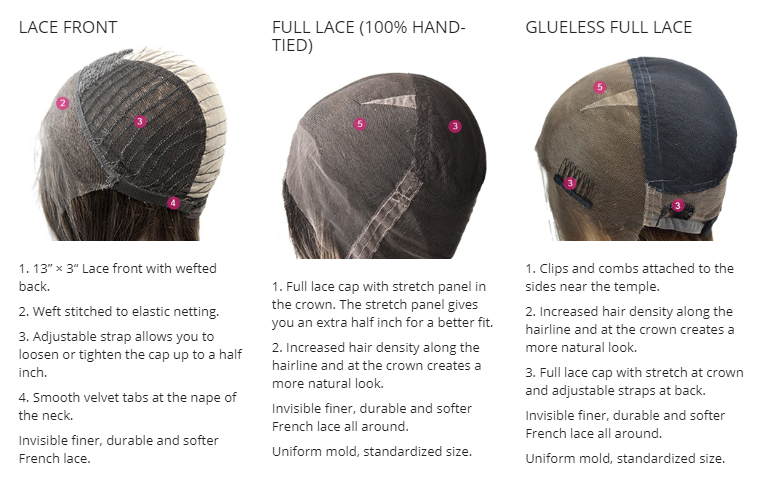
By “size,” we mean the siza of a wig cap—the base where hair strands are attached. Lace wig caps are mainly classified by how the lace is distributed on the cap, with the two main types being lace front wigs and full lace wigs. In this article, we will explain the differences between these two styles.
The Lace Front Wigs
The Lace front wigs feature synthetic lace material secured to the forehead lining of the wig cap. The smooth, delicate lace edge ensures the cap adheres securely to the forehead, creating a natural, realistic hairline for the wearer. Industrially produced synthetic silk wavy front-net wigs feature a 3-inch-wide mesh cap with a fixed webbing structure. The mesh can be secured by stretching it with clips behind the ears or adhering it to the forehead and combed into a center part to create a flawless frontal hairline.
Pros of Lace Front Wigs
- These are less expensive.
- Grants you a sumptuous, healthy, natural-looking hairline.
Cons of Lace Front Wigs
- The wigs are stable at the front but loose at the back, thus any kind of back-end hairstyle is off the menu.
- If the lace area is too small, a side-parted hairstyle cannot be achieved.
Leave a reply